Showing posts with label miscellany. Show all posts

Friday, February 21, 2014

Place Matters

by Levy Schroeder, Executive Director

As I settle into my new place after relocating to North Carolina from Washington, D.C., I’m reflecting on the meaning and importance of “place”. Place is a tough thing to define; our perspectives are unique.

However differently we define “place”, I am impressed by the importance that it plays in our lives. Place shelters us, protects us, supports us and nourishes us. It anchors us to our values and influences our choices.

Place is part of our identity. Where we live has a tremendous impact on how we live: it can determine health, economic status, educational opportunity, access to resources and general well-being.

Place stretches beyond the confines of our homes. In this age of the global market, the entire world supplies us with food, fuel, clothing and technology. Place stretches across the globe and intensifies our dependence upon its resources. No place is isolated from another.

North Carolina is beautiful place. Mountains. Beaches. Shimmering lakes, and long rambling rivers. Rolling hills rich with agriculture that grows our nation’s food supply. Thriving urban areas with all the amenities any human could need. It’s a great place for families to provide a safe and healthy place for their children to live, grow, learn and play.

But for too many in this place called North Carolina, toxic chemicals and pesticides in our food, water and air degrade the quality of life we seek in this place we call home.

When one of us is made ill from exposure to dangerous, unhealthy pesticides, or one of us is excluded from the place where decisions are made about our health and safety, everyone in North Carolina suffers the consequences. This is a sad reality for this place, but we are here together because we believe this is not acceptable.

I came to Toxic Free North Carolina because I believe we can build a truly toxic-free community. I’m proud to inherit the 26-year legacy of this strong, bold organization and to lead us through the hard work ahead on the horizon.

We will work together to build upon the tireless efforts of the founders, board members and staff. We will put a premium on our sense of place, recognizing that our community is inextricably bound to our neighbors.

We will safeguard our communities by expanding our efforts to bring much needed reforms to regulation of pesticides and toxic chemicals, and we'll work to reduce our childrens’ risk of exposure where they learn and play. And we’ll keep finding ways to make work environments safer (especially for farmworkers), and to make safer, chemical-free food accessible to everyone.

It will be no easy task, and I have a hard act to follow, but I know we can do it together. I’ve got an energetic, passionate staff, board of directors, volunteers and supporters. And most importantly, I’ve got you. This is a great place to start.

Contact Levy: levy@toxicfreenc.org or (919) 348-9789

Monday, November 11, 2013

Toxic Free NC Names Levy Schroeder as Executive Director

Schroeder brings 10 years of experience in environmental justice and farmworker advocacy to Toxic Free NC

The Board of Directors for Toxic Free North Carolina has appointed Levy Schroeder as the organization’s full-time Executive Director, effective December 2, 2013.

Schroeder brings a wealth of experience to the organization in the fields of environmental justice, food equity and farmworker advocacy. She will lead Toxic Free NC’s efforts to educate North Carolinians about pesticide hazards and common-sense alternatives to toxic chemicals, to watchdog the government agencies that regulate pesticides and toxic chemicals, and to change the way our communities view and use pesticides and toxic chemicals, especially where people are at greatest risk from exposure.

“We’re so pleased to bring Levy on staff,” said Mindy Hiteshue, president of Toxic Free NC’s Board of Directors. “Levy will bring leadership and vision to our organization and will work to expand our programs and further fulfill our mission to reduce exposure to pesticides and toxic chemicals. Levy's years of experience working directly with farmworker communities and serving nonprofits at program, fundraising and leadership levels will be a great asset to our organization.”

Previously, Schroeder served as the Director of Health and Safety Programs at the Association of Farmworker Opportunity Programs (AFOP), where she led the organization’s efforts to bring farmworker health and safety programming to its membership agencies.

“I’m excited about joining such a dynamic, passionate team, and I am looking forward to leading advocacy efforts for alternatives to pesticides and toxic chemicals in North Carolina,” says Schroeder.

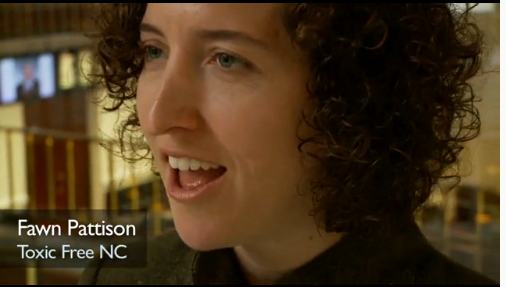
Fawn Pattison, Toxic Free NC's current Executive Director, will be moving into a new role as Senior Advocate this December. In her new position, Pattison will be focused entirely on advocating for common-sense alternatives to toxic chemicals that protect our health and environment.

Tuesday, July 2, 2013

Twelve Wonderful Years


After twelve wonderful years as Executive Director here at Toxic Free NC, I will be stepping down at the end of 2013. 

This is a big transition for us! But I am delighted to share with you that I will not be leaving the work, or Toxic Free NC. The Board of Directors has graciously created a new staff role for me focused entirely on advocacy for environmental health and justice.

More than ever, I feel a tremendous urgency around the need for toxic chemical reform. Our scientific understanding of how pesticides and other toxic chemicals affect our health and development is staggering. The gap between that science, and our food and chemicals policy in the US, and here in NC, is unacceptable. Children with cancer is unacceptable. Polluted food and water – polluted breastmilk! – are simply unacceptable. These aren’t fringe beliefs. People from across the political spectrum are demanding safer products, and public policy that supports our health and safety. Our moment is now!

As a working mother with two small children, I also feel more acutely than ever the limits to my energy. As Toxic Free NC has grown, we need a Director who can focus on building and managing this dynamic organization. I am thrilled for the chance to return to my first love (well, my first professional love): Winning our advocacy campaigns.

I very much look forward to working with a new Executive Director who will bring fresh energy and approaches to leadership. I am also grateful to all of you for making Toxic Free NC such a rewarding organization of which to be a part. 

Thank you for supporting us, and for sticking with us as we bring on new leadership. Together we are building a stronger future for our health and environment in North Carolina.

In gratitude,

Fawn 

P.S.  Visit this link for the position announcement, and please send extraordinary Executive Director candidates our way!

Tuesday, May 7, 2013

Welcome, Anna!

by Fawn Pattison, Executive Director

Toxic Free NC is delighted to welcome Anna Jensen as our new Community Organizer!

Anna grew up in North Carolina and loves every part of it, from the Appalachians to the Outer Banks. She was a Student Action with Farmworkers intern with Toxic Free NC in the summer of 2007 and has been hooked on environmental and farmworker justice ever since.

Anna can communicate in 2 languages, holding a B.A. in Spanish and English from UNC-Chapel Hill. She has worked with farmworkers in the tobacco fields of eastern NC, where she acted as a health outreach worker with the NC Farmworkers Project, and the Central Valley of California, where she conducted research for her master's thesis at UC Davis.  When not talking to farmworkers or pondering how to bridge the gap between public policy and everyday life, she can be found in the kitchen concocting something involving lots of butter and sugar.

Anna will be leading Toxic Free NC's campaigns with migrant and seasonal farm workers, as well as conducting outreach and education around the state for all our programs. She is available to give presentations and workshops in English and Spanish. Anna is also our main media contact. You can reach her by email: anna@toxicfreenc.org or by phone at (919) 833-8655.

Tuesday, December 28, 2010

My favorite moments of 2010

Looking back at a great year, I can't help reflecting on how much I love being a part of this organization and working with the fantastic supporters who make us what we are.

These were some of the highlights of 2010 for me:

I can’t wait to see what 2011 will bring, and I’m so grateful for all the great supporters who are on board with us for it. Here’s to a bright new year!

Wednesday, August 18, 2010

Get you some bug art

Thanks so much to everyone who came out to the Love Bug art show & benefit for Toxic Free NC, and to all the volunteers, artists and sponsors who made it AWESOME!

If you missed the show, or went home without some wonderful new bug art tucked under your arm, here's your chance! There's still Love Bug art for sale through the month of August. View the galleries here, or stop on by Epona and Oak before August is out to view these pieces in person.

We are also auctioning off the three remaining pieces from the finalist round! Check them out below, make a bid, and thanks for supporting us - all proceeds go to Toxic Free NC's work fighting pesticide pollution in NC.


"Caterpillar Party," by Paul Dumlao
8.5x11, ink on paper
Bid on this drawing


"Butterfly Queen of Hearts," by Pete Sack
8x10, ink and watercolor on paper
Bid on this drawing


"PBR Bug Party," by Bart Cusick
8x10, ink on paper
Bid on this drawing

Friday, September 5, 2008

Community Organizing 101: Building community, strengthening democracy, and getting things done.

It's true, most people don't know what the heck I mean when I say that I'm a community organizer. But even though the term is unfamiliar, I think most people would readily recognize "organizers" in their own communities as leaders and connectors - the proverbial "movers & shakers." Anyone who's ever put together a community event like a fundraiser, service project, strike, boycott, or protest; started a new club, organization, union, or other group; asked people to sign a petition, contact their representatives, speak at a public meeting, or vote for a certain person or proposal was probably doing some community organizing.

Community organizing encompasses a really broad range of activities and issues, and many different kinds of people do it. Some are volunteers or concerned citizens, while others do it professionally; some do it as part of a congregation or organization, while others do it independently. But there are a few common threads that I think are the most important parts:

1. Making changes & getting things done. At the most fundamental level, community organizing is a process by which people get together - "organize" - to get something done. This could be changing a rule or policy, getting someone elected, starting a new group or program, stopping something hurtful to the community, or starting something needed and helpful. Whatever it is, people come together to make a plan and then do it together.
2. Community. Communities of people are built and strengthened by the process of community organizing. When a good organizer runs a campaign or project, the community is stronger when it's over, regardless of whether they actually won or accomplished the original goal. The people involved have built relationships, skills, knowledge, and confidence that make them more active and effective participants in their community, and make future community organizing projects easier and more successful.
3. Power, Equity and Democracy. In theory, a democratic process means that people who are affected by a particular decision get a equal say in how it's made, or at least an equal say in who gets to make it (i.e. through electing representatives). But in reality, that is often not the case. The dynamics of power, privilege, and profit in our society mean that the system isn't always fair, and some people can't get what they need through normal channels. Maybe they can't get pollution out of their air or water, can't get their child's public education improved, or can't get a fair living wage. Community organizing helps to correct injustices and fix an inequitable system by bringing people together to exercise their power as a voting block or a customer base, and demand the changes they need.

In our work at Toxic Free NC, this shows up as parents who want to get their schools or childcare centers to stop using pesticides, farmworkers or farm neighbors who don't want to be sprayed, consumers who want better access to food grown without pesticides, and lots of other things too. So, we work with these groups of people to help them get what they want, and in the process we build community and correct imbalances of power that create injustice and weaken our democracy. It's pretty heady stuff, and we're proud to be doing this important work in North Carolina.

Interested in getting organized in your community, and reducing pesticide pollution? We're here to help - please contact us!

Interested in becoming an organizer? It's a pretty great job, if I do say so myself. Here are a couple of my favorite resources:
Midwest Academy
The Community Toolbox

PS: I really like this quote I just found from Mike Miller of the Organize Training Center:
Organizing does two central things to seek to rectify the problem of power imbalance - it builds a permanent base of people power so that dominant financial and institutional power can be challenged and held accountable to values of greater social, environmental and economic justice; and, it transforms individuals and communities, making them mutually respectful co-creators of public life rather than passive objects of decisions made by others.

Wednesday, January 23, 2008

Service

This week PESTed celebrated the life and work of Rev. Martin Luther King, Jr. by honoring our volunteers. At a volunteer appreciation party on Monday at DesignBox, we got a chance to say "thank you" to some of the wonderful people who give of themselves to make the movement for pesticide reform and a toxic-free North Carolina possible.

The King holiday was set aside by Congress as a national day of service in 1994, in order to encourage Americans to carry out one of Dr. King's great themes: that of service to others. We thank our volunteers in this same spirit, that of recognizing that greatness comes not from one's achievements and one's status in society, but from the greatness of our humility and our devotion to humankind. Dr. King gave his famous sermon on service, "The Drum Major Instinct," at Ebeneezer Baptist Church in Atlanta in 1968. Here is a portion of that sermon, which I know you will recognize:
And so Jesus gave us a new norm of greatness. If you want to be important — wonderful. If you want to be recognized — wonderful. If you want to be great — wonderful. But recognize that he who is greatest among you shall be your servant. (Amen) That's a new definition of greatness.

And this morning, the thing that I like about it: by giving that definition of greatness, it means that everybody can be great, (Everybody) because everybody can serve. (Amen) You don't have to have a college degree to serve. (All right) You don't have to make your subject and your verb agree to serve. You don't have to know about Plato and Aristotle to serve. You don't have to know Einstein's theory of relativity to serve. You don't have to know the second theory of thermodynamics in physics to serve. (Amen) You only need a heart full of grace, (Yes, sir, Amen) a soul generated by love. (Yes) And you can be that servant.

Take a minute to read the whole sermon (and even listen to moving audio excerpts) at the website of the Stanford MLK Papers Project.

Like our wonderful volunteers, I hope that you will be moved to serve others every day, long after the National Day of Service is over.

P.S. Thanks also to those who sponsored our volunteer appreciation party and helped us say "thank you" to some of those who serve: DesignBox, Neu Romance Entertainment, The Carolina Brewing Company, and Susan Barringer Wells. Here are some pictures from the party for your enjoyment!

MLK Day Volunteer Appreciation Party

Wednesday, October 10, 2007

Updates from PESTed HQ

Hello dear fair ground readers! Several updates for you:

* Welcome to our (new and hopefully improved) blog. We apologize that we were looking so shabby there for a while, and hope you'll hang in there with us for a few more weeks while we work out the kinks with our new system. I'll let you know when it's time to update your links.

* We're proud to introduce PESTed's newest staff person to the blogosphere: Ana Pardo, Communications Coordinator. She's working to expand PESTed's Spanish-language outreach and organizing work, and improve media coverage of our work in both English and Spanish. You'll also get to hear from her on fair ground - look out for future posts authored by "Ana."

* Today (Weds, Oct 10th), several North Carolina public school systems are being honored for their progress in implementing least-toxic Integrated Pest Management (IPM) programs at a ceremony in Raleigh. PESTed's Fawn Pattison will be speaking, along with Fuquay-Varina High School environmental science teacher Randy Senzig, and several state officials, most notably NC Superintendent for Public Education, June Atkinson. Congratulations to all the honorees!
>>For a complete list of today's School IPM honorees, click here (downloads a PDF file).

>>Don't see your school system on that list, and wondering what they're up to? Take Action!
Check out PESTed's most recent Action Alert - Readin', Writin' and Riddin' of Bugs - for information about the rights of parents and teachers under the NC School Children's Health Act, and a sample letter you can send to your school system.

>>For more information
on School IPM and PESTed's Toxic Free Kids program, click here.

* The latest news on the Ag-Mart case is not so great, and not actually all that new, but still very frustrating. From the Raleigh News & Observer, dated Oct 9:
A judge has recommended that the state Agriculture Department drop nearly all its 369 charges of pesticide violations against tomato grower Ag-Mart, the company announced Monday.

In a ruling issued last week, an administrative law judge said Ag-Mart should pay $6,000 in fines, down from an original fine of nearly $185,000.

But, as the article notes: "The final decision on the case still rests with the state Pesticide Board, as the judge's ruling is only a recommendation."

>>Full article from the Raleigh News & Observer

>>Don't like what's going on? Take action - you can start by writing a letter to the editor. Visit a PESTed Action Alert on Ag-Mart for tips - it's a little out of date, but the advice for writing a letter to the editor is still a-o-k. You may also be interested in other ways of taking action - just contact us for more ideas.


* Last, but definitely not least - Buggin' Out! Our first of three screenings of this zany reel of vintage film strips about bugs and pesticides took place in Raleigh last Sunday night, and was a huge success. Thank you very much to A/V Geeks' Skip Elsheimer, Tír Na Nóg Irish Pub, volunteers Heather, Robyn and Kate, and especially to everyone who came out to enjoy the evening and donate to PESTed. We really appreciate your support!

>>Did you miss the show in Raleigh? It's not too late to see Buggin' Out! in Greensboro on 10/20 or Chapel Hill on 10/21! More information here - please save the dates, and tell your friends and family to come join us.

>>Can't make it, but want to contribute towards making Buggin' Out! a success? Contact us to find out what we currently need in the way of volunteer help and supplies, or make a donation any time on our website.
That's all the latest news from PESTed HQ. Have a great week!