![]() |
| Yesenia and Neftali braved brutal cold at the Capitol last week to speak out about pesticide safety. |
Monday, January 13, 2014
Polar vortex, pesticides, red tape can't stop us!
Wednesday, October 23, 2013
Friendship Gardens Provides Fresh, Local Food to the Charlotte Community
It all started with a void in fresh produce. The local meals-on-wheels program in Charlotte, Friendship Trays, had always relied in part on farmers donating fresh produce, but it wasn't enough. Friendship Gardens was created to fill the void by connecting local backyard gardeners with Friendship Trays.
Kathy Metzo, Friendship Gardens' Development Director, explained that Friendship Trays used to rely on "donations from grocery stores, frozen vegetables, and fresh vegetables from out of state".
The small garden they started out with did not come close to providing 750 meals a day, so they branched out and began adopting community gardens. "Our goal was 16 gardens, but we had 36 gardens in 2 years, and now we have at least 55 gardens," Kathy said. Some adopted gardens were already in existence, and some were assisted by Friendship Gardens from the ground up.
Friendship Gardens supports volunteers in their backyard gardening program every step of the way. From providing free seeds, food safety and garden training to providing a space for friendship and sharing information, participating gardeners have the tools to succeed.
The large garden network enables support and resource sharing among gardens. Potluck meals allow volunteers and gardeners to connect with each other in an informal setting. According to Kathy Metzo, structured workshops give novices a baseline, and those who garden by trial and error learn the science behind gardening.
Even though Friendship Gardens is based on giving, its success is likely due in part to recognizing that gardeners must enjoy their own harvest. Their Homegrown program improves food access for residents of Habitat for Humanity homes by setting up small residential gardens. They use hearty plants for the new gardeners. This way, participants quickly see the fruits of their labor so they will continue gardening.
The same principle is applied to the backyard gardeners. Friendship Gardens encourages garden volunteers to keep some of the harvest themselves in addition to donating a portion of it to Friendship Trays.
As Kathy Metzo puts it, "Last summer I sautéed some vegetables [from her own garden] in a pan: tomato, okra, and zucchini, with a little olive oil, and sprinkled on some mozzarella. It's simple. You feel like no matter what you grow, how awful a gardener you are, no matter how awful your harvest is, you're still feeding yourself. Even if you just have two okras, one tomato and a zucchini half eaten by worms, you can put half of the zucchini in the compost and eat the other half."
---
Friendship Gardens was a nominee in Toxic Free NC's 1st annual Save a Bee Beehive Giveaway in 2012. With support from The Burt's Bees Greater Good Foundation, we award a beehive and organic gardening support to a NC community garden working on food access issues in our state.
By encouraging organic gardening and promoting pollinator protection we hope to make it possible for community gardens in NC to grow even more healthy, pesticide-free food for their communities.
Find out more about Toxic Free NC's Save a Bee Beehive Giveaway and how you can help protect pollinators and support community gardens near you.
Thursday, August 8, 2013
Farewell to a great summer intern!
![]() |
| Summer Intern Mervin Davis |
Friday, June 14, 2013
Make an impact – Volunteer at Toxic Free NC!
Monday, July 12, 2010
Agrarian Road Trip with the Presbyterian Hunger Program
After interning with Toxic Free NC in the summer of 2009, working specifically on farm worker advocacy, I was left with the nagging sensation that the global food system was seriously ill. I learned first-hand about the symptoms of the sickness through sharing stories with farm workers who provide much of the labor that keep the food system chugging along. Pesticide exposure, poor housing, and unsafe working conditions were just a few aspects of the status quo that I not only heard about, but saw with my own two eyes. It wasn’t hard to come out of the summer with the idea that the food system is an unbridled beast, a problem that neither law nor economy would be able to fix.
Then, in the spring of 2010 I heard about the Presbyterian Hunger Program’s Agrarian Road Trip to the US Social Forum. Although the name is a total mouthful, the idea is quite simple: get together 15 people from across the country to road trip through eight states and visit just and sustainable agricultural projects. Or, in other words, my dream vacation. This trip gave me the opportunity to see the local agriculture movement as up close and personal as I saw the problems with conventional agriculture, and learn about much needed local solutions to national and global problems!
We toured from Louisville, KY to Detroit, MI by way of Berea KY, Maryville TN, Asheville NC, Wytheville VA, Mullens WV, and Youngstown & Cleveland OH (map). I’d like to report on the NC projects that our group visited and commend your state on a fantastic variety of agrarian projects!
The Veteran’s Restoration Quarters and Transitional Housing in Asheville, NC is a converted Motel 8 with over 150 rooms. According to Director Michael Reich, the facility is in the top 5 of 600 similar facilities in the United States, evidence that they run a tight ship! One project, the Victory Garden, was started by two current residents who asked for a garden when they moved in. They now work a large piece of land sunrise to sunset every day of the week. This victory garden not only provides food to the men’s quarters, but also to the women’s quarters in the city. The two men also run a weekly tailgate market to support their project! Produce also goes to the culinary classes where other veterans work to develop skills. The Victory Garden serves the community: it is not divided into plots for different people, it is a garden that is completely communal. While giving us a tour, the men mentioned their composting initiatives and also their use of IPM. In the photo to the left, Ed, a resident of the Veteran’s Restoration Quarters talks with Talitha, a Road Tripper from California. If you look closely, you can see a patriotic scarecrow in the background!
The Free Store at Warren Wilson College was started in 1999 as a part of Warren Wilson College’s super progressive recycling program. As a college student, I was blown away by WWC’s initiatives across campus: local food advocacy in the cafeteria, sustainable ag practices taught in the classroom, and an eco-dorm for leisure activities! As a college student, I am also sensitive to big-budget college spending vs. small-budget college student saving. The project that I saw that really appeared to not only be cutting-edge environmentally but also progressive socially was the Warren Wilson Free Store. The Free Store is an initiative to divert waste from the landfill – the message on their website is clear: “If you have some stuff you want to get rid of, no matter what it is, and you think that someone else might still be able to use / salvage it, bring it down.” Shelves upon shelves are filled with half-used shampoos, old cell phone chargers, dirty shoes, and suitcases. Just about everything a college student would throw away is found there, and more! I even picked up a “Warren Wilson Admissions” polo shirt. This project is part of WWC’s awesome recycling program, which you can check out here.
Our group spent the night at Warren Wilson College and had the pleasure of making Marc Williams’, local ethnobotanist, acquaintance. Marc led us through a meal that used over 30 ingredients, the vast majority local and harvested just that day. The menu included: herbal tea of monarda, spearmeint, sassafras leaves; pesto of lamb’s quarter and basil; garden salad with more lamb’s quarter and lettus, garnished with day lilies and monarda (left); and for dessert, juneberry-blackberry cobbler. Marc Williams, our favorite genius, is an ethnobotanist, teacher, chef, and farmer who went to Warren Wilson College and Appalachian State University. He is leading an online course that is donation based and based on the book Botany in a Day. Check it out!
One last story I’d like to tell is about a lunch our group shared in Brevard, NC at Fred and Elizabeth Bahnson’s homestead. Because our trip was sponsored by the Presbyterian Hunger Program, we often spent time with theologians and learned specifically about faith-based organizing around the local foods movement. The Bahnson couple, who are building an eco-house just up the hill from their gravity-fed edible forest and permaculture garden (idyllic, no?) are both theologians who met at Duke Divinity. My fellow roadtripper Bethel (her blog here) describes the Bahnson’s projects with detail:
Where the Bahnsons live is actually a microclimate in the midst of the mountains – a tropical rainforest, receiving nearly 80 inches of rain each year – as much as Seattle. As they build their new house, the Bahnsons have planned to harvest the rainwater, situating their catchment system on top of a hill – to gravity-feed to their biointesive growing beds. In addition to rainwater catchment, Fred has designed swales on the contour of the land to irrigate native fruit trees and prevent erosion on the steep slope on which their farm is southerly-facing. Other highlights of their farm-to-be are living mulches that fix nitrogen (lupine) and accumulate other deep nutrients (comfrey), as well as growing their own grains (Hopi blue corn for grinding). Elizabeth is currently dreaming of a goat dairy.
If you are interested in the connection between food and faith, check out an article Fred Bahnson co-wrote for the organization he founded, the Anathoth Community Garden. He points out, as many agrarian theologians do, that human and humus are not so far apart, a fact often supported by the Bible’s stories. The Bahnson’s are a living example of a desire to serve the soil rather than dominate it.
Tuesday, May 18, 2010
on "natural" meats and choosing local & organic
Guest post by Toxic Free NC volunteer Hayes Simpson.
I was forever changed a couple of weeks ago, and will henceforth always practice the “sniff test method” before I begin to cook any type of food with an expiration date!
Here's the story: I went food shopping on a Thursday, went out of town for the weekend, returned on a Sunday afternoon. Later in the afternoon, I chopped some onions, crushed some garlic cloves, and set out spices for the whole chicken that I intended to roast. I unwrapped the chicken, plopped it on a roasting pan while the oven preheated, and Whew! All of a sudden something was amiss; the air was thickening with a fetid odor that begged to be extinguished. First I ran to the bathroom, then to the shamed chicken, which I quickly double bagged and carried out to the garage. But, when I checked the slimy wrappings, the "sell by date" was for that very day!
For one thing, I probably should not have left uncooked chicken in the fridge for that long. Check out this Food Storage Guide. Fresh poultry is supposed to spend only one or two days in the fridge, oops! Us “master chefs” learn something new every day!
But here's a little more background on this chicken… I purchased it from a grocery store where I don't normally shop because they don't carry many organic products. But shop there I did, and seeing no great meat choices in the freezer section, I chose a whole chicken from behind the meat counter display case. It was labeled “natural” and had been produced on a “farm.” I think it was the word “natural” that sold me.
So, what does the label “natural” mean when it is applied to meat and poultry? The USDA says that meat and poultry labeled “natural” must not contain artificial flavoring, color ingredients, chemical preservatives, or artificial or synthetic ingredients, and can only be processed “minimally.” Really, the “natural” label refers to what happened to the animal product AFTER slaughter. This means that so-called "natural" products could contain pesticides, added hormones, or antibiotics! Pesticides and other pollutants build up in the fatty tissues of livestock that are exposed to them. When we consume animal products that have pesticides in them, those chemicals wind up in our own bodies. Unlike microbial contaminants, we can’t "kill" pesticides and other chemical pollutants by cooking them away. For more info on pesticides in food, go to: http://www.whatsonmyfood.org. It seems there could have been quite a few pesticides in that rotten chicken that I thankfully did not eat! (Maybe it was a blessing in disguise.) Too bad I can't "sniff test" for pesticides in my food!
We meat eaters do not have to abandon hope just yet, however! We have the option to shop for local, sustainably produced, pasture-raised animal products. Pasture-raised meat is leaner, higher in Omega-3s, has been shown to help lower LDL cholesterol levels, and is MUCH less likely to contain harmful bacteria and pesticides. This site provides a great summary of research on the health benefits of pasture-raised, "grass fed" meats.
Lucky for those of us in the Triangle area, we are surrounded by plenty of alternatives for purchasing healthy, sustainably-produced meat, poultry, and dairy products. A great resource is the Triangle Meat Buying Club. Members order their meats online from a local farm. Each month, participating farms are listed along with the products they offer. You place an order online, then simply pick up your order from the farmers at the designated pick-up site. This sounds sooo much more pleasant than scrutinizing labels in the meat department of a crowded grocery! And, you can’t beat getting to shake hands with the person who actually helped produce the meat that will soon be on your dinner plate. (The photo above is from one of the Triangle Meat Buying Club's suppliers, Coon Rock Farm in Hillsborough.)
For more information on pasture-based local producers look at the NC Choices site.
I know that I will feel much more comfortable adding wholesome, fresh chicken to my meal plans, perhaps some beef tenderloins for special occasions, and I can’t forget the delight of Sunday morning bacon. Perhaps my nose can relax now too!
Thursday, April 15, 2010
not all germs are bad
Guest post by Toxic Free NC volunteer Andrea Restle-Lay, Moderator of Five Points of Raleigh CSA
Not all germs are our friends, it’s true, and they can turn into true enemies. It’s no wonder H1N1 swept us all into a panic!
I’ve heard lots of stories over the years: a neighbor has MS; my high school friend has celiac disease (a.k.a. gluten allergy); friends and relatives die of cancer; schoolmates started suffering sudden, life threatening peanut allergies and asthma; my own son picked up a cold which turned into an odd, barking cough that went on forever and was impervious to medications. My own research has shown that all these issues may be related to hyper-immunity, or the body’s immune system turning against itself. But why? What is wrong with everyone’s immune system all of a sudden?
One explanation comes from the Hygiene Hypothesis, developed after a failed experiment in Germany in the late 1990s. Dr. Erika Von Mutius hypothesized that children who grew up in poorer East Germany would be more likely to have asthma and allergies than those in wealthier West Germany. In fact, after reunification she discovered that exactly the opposite was true – children in East Germany were less likely to have asthma and allergies! So she developed a new theory – the hygiene hypothesis - that a child’s early contact with dirt, animals and other children exposes them to many microbes and allergens, and this helps their immune systems develop strong and healthy.
There has been much debate in the scientific literature since that time about the validity of this idea, and how exactly it works. There is such a thing as a good germ – in fact, there are billions of good bacteria at work in all of us, helping us to digest our food properly, heal from skin wounds, and more. Overdoing it on the antibacterial soaps, cleaners and sanitizers, not to mention antibiotics, may kill off too much good bacteria and throw our bodies out of whack. What’s more, antibacterial ingredients added to many household products are actually pesticides, with toxic effects on our health and on the environment. More about that in a previous blog post.
Opponents of the hygiene hypothesis point to inner-city populations in the US. Living in more crowded housing and spending more time in daycare should mean higher exposure to germs and lower risk of asthma and allergies for inner-city kids, right? But no, rates of asthma are in fact much higher than for other American children. However, inner-city kids may also face a lot of other exposures that increase their risk for respiratory illnesses – things like diesel exhaust, industrial pollution, and pesticides. Diet may also play a big role.
Some good sources to check out on this issue include:
Jessica Sachs’ Good Germs, Bad Germs: Health and Survival in a Bacterial World
Dirt’s good for kids from the Chicago Tribune
So what can we do as parents to raise healthy children free of immune diseases AND the flu?
- Educate your children’s immune system every day by exposing your children to plenty of environmental nuances - (non-poisonous) backyard plants and flowers, fields of weeds and wildflowers, get a kiss from a neighbor’s well-behaved dog, investigate some bugs, pick up some earthworms. Feed your kids local honey every day after they reach one year of age. Let them get dirty and make mud pies in the backyard.
- Wait to serve solid food until six months. Start with low allergy risk foods like sweet potatoes, oatmeal and apples but avoid things like eggs and nuts early on.
- Flood those little bodies with healthy antioxidants to help their immune systems remain strong, especially after a cold or vaccination when young immune systems are most likely to overreact. A delicious organic berry and local honey yogurt smoothie or even chicken vegetable soup can do the trick!
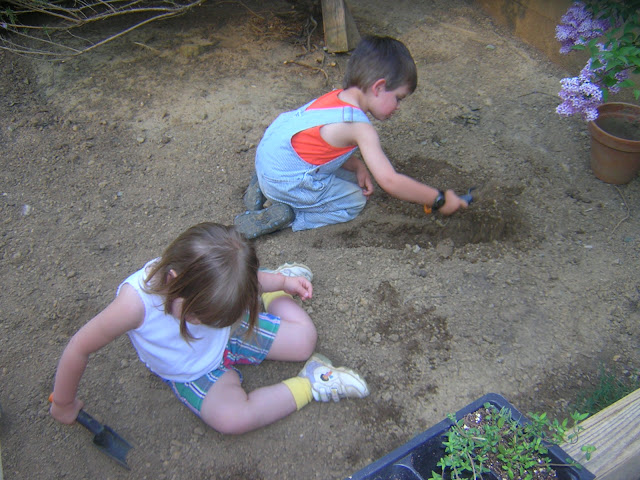
- Join a Local CSA farm and feed your family a variety of fresh, local, organic fruits and vegetables, serve uncooked foods when you can and visit the CSA farm so your kids can play in their dirt, too. (The photo above is of two very happy kids in the dirt at Killen Farms in Pittsboro, NC - courtesy of Jennifer and Jason Killen.) Take your children to the Farmer’s Market and let them try free samples whenever you can. Look on www.LocalHarvest.org for resources nearby.
- Don’t use pesticides around children! No matter what you think about the hygiene hypothesis, know that the same argument does NOT apply to pesticides and other toxic chemicals. Children are more sensitive to health damage from pesticides and many other pollutants than adults are, so it’s extra important to keep their environments toxic-free. Try natural methods instead - you can get some ideas for least-toxic pest control methods from Toxic Free NC’s website.
Monday, April 12, 2010
Tips for Avoiding Genetically Modified Foods

Guest post by Toxic Free NC volunteer Hayes Simpson
For a long while now, I have carried around an index card in my wallet billfold, which contains a list handwritten by my own dear Mama. The list includes the top fruits and veggies to buy organic (as in the Shopper's Guide to Pesticides in Produce from Environmental Working Group). She also listed fish and shellfish that contain fewer toxins (as in the Seafood Selector from Environmental Defense Fund).
I’m sure that many of you are familiar with these lists and others like them, and they may have changed your buying habits in a big way, or maybe just when it comes to certain staple foods, such as apples, spinach, and potatoes. I'll admit that it was only once in a while that I remembered to check my Mama's list.
But another closely-related food issue has caused me to stop consuming sodas, and to “floor-it” when my stomach is grumbling and the golden arches are beckoning. I am talking about the unsavory subject of GMO’s which until recently brought to my mind visions of acres of picture-perfect, bright yellow, completely inedible corn, and futuristic, square watermelons stacked neatly into a towering pyramid for display purposes.
I was lucky enough to be introduced to some information that really helped me to put my limited knowledge about organic food shopping and genetically modified foods into context. It started when I was shown a clip from the film, Everything you HAVE TO KNOW about Dangerous Genetically Modified Foods.
I learned that, in fact, the crops that are most likely to be genetically modified are corn, soybeans, canola, and cotton. Very few fresh fruits and veggies sold in the U.S. currently are genetically modified, but did you know that there are dozens of common ingredients derived from the big four GM crops that may be genetically modified? In the words of my two year old, “Ewwwww!” So the best advice for keeping GMOs off your plate is to read labels, and know that anything containing one of these ingredients is questionable, unless of course the product is marked "certified organic" or "non-GMO."
The film explains that there are a some very serious health concerns about genetically modified ingredients, including the potential to cause allergies. More information is available at: http://www.responsibletechnology.org They also provide an excellent Non-GMO Shopping Guide (in case your Mama hasn’t already made you one.)
Good luck, and eat well!
Tuesday, February 23, 2010
America's Most Wanted Toxic Chemicals
Campaign Director, Safer Chemicals, Healthy Families
Reposted with permission
One way we'll know that Congress is serious about reforming the nation's chemical laws is by how they address a group of extremely dangerous chemicals that are the equivalent of the FBI's "Most Wanted" list: Persistent, Bioaccumulative Toxins or PBTs.
Some of the most notorious chemicals ever studied are PBTs - lead, PCBs, DDT, dioxin mercury, and cadmium. Many PBTs, including flame retardants and the stain-resistant perfluorinated chemicals (like PFOA used to make Teflon), are still found in products we use every day in our homes and places of work.
Persistent, toxic chemicals build up in our bodies and are passed on to the next generation. This is especially troubling to parents like Molly Gray, who want their children to have safe, happy and healthy lives that are free of toxic chemicals that may harm their health.
Molly's concern for this issue is deeply personal. Molly was part of a study that tested pregnant women for toxic chemicals; their developing babies were exposed to these chemicals during pregnancy.
Molly thought she'd test chemical-free because in the five years before becoming pregnant, Molly had done everything she could to reduce her exposure to toxic chemicals, including eating organic food, choosing low-mercury fish and avoiding personal care products with phthalates and fragrances.
Instead, despite taking precautions leading up to her pregnancy, Molly learned she had the highest levels of mercury – a PBT – of all the women tested in the study. And she tested above the national average for other chemicals tested, including phthalates, BPA, flame retardants, and "Teflon" chemicals.
We helped get Molly and her seven-month-old son Paxton to Washington, DC so she could tell Congress that what we don't know about toxic chemicals is harming real people, right now.
Senator Frank Lautenberg, who will soon introduce legislation to update the nation's chemical safety law, expressed concern, saying, " … in essence, the American public has become a living, breathing repository for chemical substances. And when the chemicals…show up on our children's bodies, we have a potentially dangerous situation."
The Safer Chemicals, Healthy Families coalition agrees with Senator Lautenberg. We believe it should be a no-brainer for Congress to put PBTs on a pathway to phase-out when it reforms
the Toxic Substances Control Act (TSCA).
Unfortunately, even no-brainer ideas have run into trouble recently, thanks to the lobbying efforts of the chemical industry. The chemical industry is trying to avoid action by convincing Congress that the right thing to do is to spend more years "studying" chemicals; chemicals that scientists have already shown to be notorious and dangerous.
Please write to your member of Congress to tell them that real TSCA reform will include taking immediate action to phase PBT chemicals out of commerce.
Wednesday, December 16, 2009
Research links Pesticides to Autoimmune Disease
Yet another reason to question use of pesticides in the home: it has recently been linked to autoimmune disorders such as rheumatoid arthritis and lupus. In a study presented at the American College of Rheumatology’s annual meeting earlier this year, researchers concluded that women who sprayed pesticides at least six times a year doubled their risk of autoimmune disease. This risk was the same whether the pesticide was applied professionally or not. Read the rest of the story here, but that’s not the beginning of the journey nor is it likely to be the end.Autoimmune responses in a nutshell describe the process of the body attacking and destroying healthy and important cells. It’s like sending the baby out with the bathwater, as the saying goes. The signaling pathway within the body that leads to the miscommunication is still not understood, and likely to be different depending on the person and the tissue attacked. Environmental exposures, however, are implicated as triggers.
The only human study done to date involved a spill of the pesticide hexachlorobenzine (HCB) in Turkey, where residents near the spill showed a drastic increase in autoimmune disease. Compared to previous studies on HCB, humans showed a much more sensitive autoimmune response, suggesting that animal models may provide only a conservative estimate of which exposures will show an effect in humans.
Most people are left with this review of the medical literature with their head in a kind of cloud as to what the data are really showing. Since almost all studies show some effect of pesticides on autoimmune responses, the precautionary principle should be invoked. It’s another case of the need to limit exposure to chemicals that may cause devastating disease in the future, because you may be one of the lucky few with genetic resistance to autoimmune disease, but your loved ones might not be.
Thursday, December 3, 2009
December 3, 1984

By guest blogger Allen Spalt
Today is the 25th anniversary of the disaster at Bhopal, India.
When the badly designed and improperly maintained chemical tank failed at the Union Carbide pesticide plant in Bhopal and sent a cloud of deadly methyl isocyanate (MIC) gas over the city killing thousands in the middle of the night, it was the world's works industrial "accident." It also poisoned thousands of others with health effects that linger today (for those who have survived that long).
For me, it is a strong reminder and impetus for our work. It was also totally unnecessary in at least two ways.
First, the pesticides being manufactured there, carbaryl (Sevin) and Aldicarb, can be made with a 'flow through' process that does not require the use of intermediate holding tanks for the MIC which is used in the manufacture of the final products. In fact, at the time, Bhopal's sister plant in Institute, West Virginia, did not contain such tanks. Better oversight and maintenance might have prevented the leaks, of course, but in fact the tanks were not even necessary. Just cheaper. So to save a few bucks on the process and on maintenance, Union Carbide risked the lives of tens of thousands.
Second, we work to promote alternatives which would make the manufacture of such deadly pesticides unnecessary. You don't need Sevin or Aldicarb or other similar deadly poisons in sustainable or organic agriculture. Every acre that is converted means fewer pounds of poison manufactured, sold, used, or disposed of. Fewer people at risk. Less residues in the water, soil, and food. Safer environments for our children and wildlife.
Someday it will be recognized that what has been called "conventional agriculture" for the last few decades was anything but. It is horribly out of sync with the tradition of agriculture over the centuries. With chemical intensive monocultures, it is depleting the soil and poisoning the water. It is not sustainable. The latest gasp of bioengineered crops, which promised more productivity and fewer chemicals, are proving to provide neither. They are less productive and require more herbicides and other pesticides. You know, if there is one thing the geniuses from Monsanto could select for besides Roundup-resistance, it would be greater productivity. But they haven't found it in any genetically engineered crop. More than a few critics from our side of the barn predicted this.
It is not a question of whether will we replace "conventional" agriculture with sustainable production, it is when. Otherwise we will not be sustained as a civilization.
Most indicators, fortunately, are not as dramatic as Bhopal, but they are pointing in our direction. I am proud to work with all of you on this important work to promote health and safety and to point the way to a sustainable future. Getting rid of pesticides is one important part of the struggle.
Union Carbide did not survive the aftermath of the incident, though it never paid fully for its responsibility. Its assets were sold. Work continues under other owners in RTP. The Bhopal plant was bought by Dow, which contends it has no responsibility to the victims.
On the tenth anniversary I was giving a workshop at a meeting in Atlanta and asked for a moment of silence for Bhopal. I was moved when one participant introduced himself as having grown up in Bhopal. He is one of three or four people I've met from there, the others are survivors of the disaster. Today I will take time out to remember them and others and rededicate to the task.
Join us in commemorating the Bhopal anniversary by taking action for justice in Bhopal.
Wednesday, December 2, 2009
Dow Shall Not Trespass

By guest blogger Gary Cohen, President and Co-founder of Health Care Without Harm - www.noharm.org
Twenty-five years ago, a Union Carbide pesticide factory exploded in Bhopal, India, releasing a toxic cloud that killed thousands in its wake. More than 8,000 people died within the first three days of the disaster, while more than 500,000 were exposed to toxic gases that invaded their lungs and spread throughout their bodies. For this reason, Bhopal has been called the Hiroshima of the Chemical Industry.
Twenty-five years later the abandoned factory has still not been cleaned up, but continues to leak poisons into neighborhood groundwater. A recent report by the Bhopal Medical Appeal found dangerous levels of heavy metals and persistent chemicals in the groundwater. Union Carbide executives have never been brought to trial in India, despite attempts by the Indian government to extradite them. And although Union Carbide was bought by Dow Chemical in 2001, the parent company claims no responsibility for cleaning up the mess left behind and has not submitted itself to the Indian criminal case. Rather than addressing its ongoing liabilities in Bhopal, Dow has spent tens of millions on its Human Element ad campaign, which portrays the chemical company as people-focused and caring.
The world has learned a lot about the chemical industry since the Bhopal disaster. We now know that many of the industry’s products are linked to a broad array of diseases in the general population, including asthma, cancer, birth defects, infertility, Parkinson’s disease, endometriosis, obesity and diabetes. Rather than internalizing the consequences of pollution, the industry has externalized health and social costs onto individuals and the American healthcare system, which is being crushed under the weight of ballooning costs, chronic disease and misaligned priorities.
We have also learned that we all carry the by-products of the chemical industry in our bodies. These toxins pass into us from the food we eat, through plastics in everyday consumer products, through building materials in our houses and offices, and through our water and air. The Centers for Disease Control has documented that the average American carries more than 100 toxic chemicals in his or her body. Plastic additives bisphenol A and phthalates, the pesticide 2,4 D, and shampoo additive 1,4 dioxane are among those Dow Chemical products found widely in many people’s bodies. Even children are being born pre-polluted, already filled up with a plethora of toxic chemicals that can act like ticking time bombs, triggering health impacts later in life. Without our knowledge and our consent, we and our children have become guinea pigs in an uncontrolled chemical experiment in which Dow and the other chemical companies are running.
Over the last twenty-five years, the Bhopal survivors’ plight and our own have become much more intertwined. We have all become united in a global web of chemical poisons. We have all been “branded” by the chemical industry, their signature chemicals coursing through our veins and building up in our fat tissue and other organs, whether we live in Bhopal or Baton Rouge.
Given the new political momentum in the country to address environmental issues, healthcare delivery and even corporate negligence, its time to stand up to the chemical contamination of the American people and reassert our basic human rights and religious values. As a society, we should guarantee every American child the right to be born free of industrial chemicals. And as a society committed to freedom, we should defend the freedom of women to breastfeed their infants without passing their life supply of toxic chemicals onto them. We all have a right to a toxics-free future. The laws in our country and at a global level should guarantee these rights and the environmental conditions for our health and wellbeing.
Friday, October 23, 2009
Farming American Dreams
My father was born and raised on a farm in northeastern North Carolina, where he spent summers picking, sorting, carrying, and cleaning potatoes. As his son, I think about how our lives are so different even though we are only one generation apart. I often wonder how my character would differ if I had spent my childhood in fields of corn and cotton, rather than fields of soccer and baseball. What values I’d have if my Christmas bounty and family’s wealth were tied to Mother Nature’s weather and the crop’s health.
I regret not sharing Dad’s experiences as a kid, and feel disconnected with my ancestors and environment as a result. I question whether (and fear that) it is those things I do not share with my Dad that make him the man I so admire. But it was his wishes that led him to leave the farm, pursue other interests, and raise a family in an urban setting that he thought would best suit them. He followed the path of countless farm children before him, a path many city kids desire to take back.
Goodman includes in her article an excerpt from the Gene Logsdon book ‘Living at Nature’s Pace: Farming and the American Dream’. In the excerpt Logsdon acknowledges the rise of urban farming and community based food solutions. What is driving people back to farms is the recognition that there is a need for sustainable food systems, and that the solutions require great ingenuity. Where farms were once the places parents hoped their children would escape with the help of an education, they have now become the places where the educated are returning to craft inventive solutions that help us to escape from unsustainable consumption patterns.
For some inspiring and innovative farmers check out this New York Times Magazine article profiling Will Allen (who is coming to NC in November - visit http://cefs.ncsu.edu for more information!) and the slideshow below highlighting some of North Carolina’s very own up-and-coming farmers courtesy of Mule Magazine.
Tuesday, September 8, 2009
Questions about (Toxic) County Mosquito Control in Coastal NC
Glass of cold ice tea, hibiscus and green tea with just the slightest hint of lime. Check.A good novel, one prepared to take me off to someone else’s world of romance and fantasy. Check.
Hammock, gently rocking in the wind, the taste of the air ever so slightly just flavored by the tomato plants nearby in full summer glory. Check.
I sat down, prepared to have a wonderful, relaxing afternoon to myself when I hear ‘bzzzzzt’. I would know that noise anywhere even if it weren’t directly in my ear. A mosquito.
‘Buzz, buzz, buzzzzzzut’. It tries again to get a good bite and then is joined by a friend. Great. So much for my afternoon.
I hate mosquitoes. I mean, who doesn’t? My afternoon scene isn’t foreign to anyone living in coastal North Carolina, that’s for sure. And apparently, this year’s the worst mosquito year in quite awhile, so the county has stepped up efforts to chemically decrease their numbers, as evidenced by the spray truck that comes by my house about once a week in the early morning under the banner of public health.
Wait, what?
As much as I hate mosquitoes, I’m not sure I’m ready to give in to the sacrifices of this practice that makes me think I’ve been surreptitiously transported back in time to a bygone era. One before Rachel Carson, the EPA, and the general understanding that pesticides are dangerous and should be handled with care.
So what about the cloud of chemical smoke that graced my porch this morning? Did I just become consumed in my little life bubble and miss the announcement that the county was spraying? Or was it really not announced? Did I ever have the chance of voicing concern over the practice?
A little bit of internet searching later, I found the section of the local government responsible for making such decisions: the Carteret County Mosquito Control Division, linked to Animal Control (yep, not linked to the state’s departments in charge of agriculture or pesticides, but entirely under local control). A quick call to their offices asking about the spraying I had observed that morning yielded the following information:
- mosquito control is done entirely on a county level, though practices are fairly standard and haven’t changed over the last couple of decades
- the control program uses a combination of sprays and pellets distributed in roadside ditches
- the following brands are used: Aqua-Reslin, Altosid SBG, Aquabac XT, and Altosid briquettes.
After a bit more time poking around the manufacturers’ websites (www.backedbybayer.com, www.altosid.com, and www.teamaquafix.com), I could identify the active ingredients and start connecting them to other information I knew in terms of impacts to human health and the environment. Like other chemicals, these pesticides are required to have a comprehensive label describing all the potential risks that come along with use and giving specific directions for proper handling in order to minimize those risks. This sheet was a good first stop for information – these sheets are federally required and under strict federal oversight to report all known risks. All of the products said to wash eyes or exposed skin for 15 minutes and to contact poison control if swallowed (do not induce vomiting or give them water). Here’s more specifics from what the labels say, my reactions and comments follow:
- Aqua-Reslin: Active ingredients are permethrin and piperonyl butoxide. It’s intended to be a space spray for adult mosquitoes. It is not to be applied within 100 feet of lakes and streams and exposed drinking water (such as fountains or cattle troughs). My favorite is the environmental hazards section: “This pesticide is extremely toxic to fish and aquatic invertebrates. Do not apply directly to water, to areas where surface water is present or to intertidal areas below the mean high water mark… This pesticide is highly toxic to bees exposed to direct treatment on blooming crops or weeds. Do not apply this product or allow drift when bees are actively visiting the treatment area.”
- Altosid SBG/briquettes: Active ingredient is s-methoprene, designed to kill larvae as dosed in their breeding pools. They mention no particular risks other than “do not contaminate water when disposing of rinsate or equipment washwaters”.
- Aquabac xt: Active ingredient is Bacillus thuringiensis, a bacteria that kills larvae of a wide variety of insects. They include the same statement about contaminating water as Altosid. These directions seem innocuous enough, easy to follow, and targeted at the nuisance. However, upon closer examination of the coastal environment upon which these chemicals are being applied yields a number of questions followed by surprise that these chemicals are standard practice considering the total effects.
Second, I’d like to tackle the 100 feet of lakes and streams directive. I live pretty close to the center of a fairly small island, surrounded by water on all sides just a few blocks from my house. Presumably, also, the spraying truck also covered the streets closest to the estuaries where some of the densest housing is located. Did they stay 100 feet from bodies of water that contain productive fisheries? Not if they went over a bridge.
Third, related to the question of bees. Most people by now have heard of colony collapse disorder (CCD) occurring across the country in honeybee colonies. These colonies are critical to agriculture, bringing pollen to stamens everywhere and allowing us to enjoy squash, tomatoes, eggplant, apples, peaches, and the list goes on. I’ve personally noticed a lack of honeybees in my personal garden this summer, rendering my beautiful vegetable plants sterile. I’ve even tried to do the job myself, out in the early morning with a q-tip trying to think like a hungry bee, but to no avail. I’ve had one tomato out of a plot of 3 tomato plants, 4 squash, 4 eggplants, and a more wildflowers than I can count. CCD (see http://www.oardc.ohio-state.edu/agnic/bee/ccd.htm for more information) is as of yet unascribed to any particular cause, but I have my guesses.
Finally, the more general point about “do not contaminate water” with the anti-larvals. Although this sounds simple, a couple of considerations may require a second thought. The area is comprised of soil made up almost entirely of sand, which allows water, pesticides, and any other runoff to directly enter the drinking water supply that sits directly below our island. Also, the tablets are applied to roadside ditches and puddles that connect directly to…you guessed it, bodies of water! Work by Costlow and Bookhout, professors at the Duke Marine Lab, in the 1970’s established that methoprene and permethrin directly kill blue crabs, shrimp, and other invertebrates in the estuaries. This not only disrupts the ecology of the estuaries (which, incidentally are federally protected preserves, the Rachel Carson Estuarine Research Reserve and the Lookout National Seashore), but directly costs the area jobs in terms of declining fisheries.
I encourage everyone to look into their local pest control programs and find out what the operating practices are. You might just be surprised.
guest post by Amy Freitag